(This is a mirror site of my webpage karenjcarlisle.com)

Sunday, October 16, 2016

Fingerprints: Identification vs. Investigation

original post: http://karenjcarlisle.com/2016/10/16/fingerprints-identification-vs-investigation/

Modern forensics is amazing. Scientists can tell you blood type, DNA profiling, retrieve fingerprints from most unlikely places. If there is evidence, the culprit can be identified. We take it for granted. But did you know DNA wasn't used until 1985?
In 1888 - at the time of Jack the Ripper - policing was a lot different than it is today. Scotland Yard's Criminal Investigation Department of detectives had only existed since 1878. The media, and the public, thought them a joke. Punch described them the Defective Department and the Criminal Instigation Department (3).
When London was gripped in fear over the Whitechapel Murders, there were few modern procedures to aid in investigation. By the end of Jack's spree, police investigation was already starting to change - by necessity. One of the most obvious aids to securing the identification of the killer were 'chance impressions' - what we call fingerprints.
Let's take a closer look at fingerprints. Would Doctor Jack linger at a crime scene to wipe it clean?
Not likely. He probably didn't even know what they were. But the Metropolitan Police did and - if they had heeded the advice of a village surgeon ahead of his time, and that of a Scottish surgeon forty years later -  perhaps Doctor Jack may have been identified.
The first recorded evidence of fingerprints was in 1665, when Italian physician, Mercello Malpighi, wrote of the existence of fingerprints (2). The first scientific paper to describe fingerprints was written by English physician, Nehemiah Grew, in 1684 (6):
'with a Ball he may perceive besides those great Line s to which some men have given Names and those of a middle size call d the Grain of the skin innumerable little Ridges of equal bigness and distance and e very where running parallel one with another And especially upon the ends and first Joynts of the Fingers'.
German, Christoph Andreas Mayer, reported them to be individually unique in 1788 and a Czech physiologist  published a thesis discussing 9 fingerprint patterns in 1823.
Scotland Yard's first chance to use this new technology was in 1840. A village doctor, Doctor Robert Blake Overton, wrote to Scotland Yard, suggesting they check the reported bloody fingerprints found on a bed sheet, in the murder of Lord William Russell. To give them their due, this was followed up, with 'no such marks' found. Unfortunately they did not realise their potential and there was no change in investigative procedures (5).
In the meantime, research continued elsewhere in the world, with William Hershel using fingerprints to identify villagers in India in 1858, and Paul-Jean Coulier discovering iodine could reveal fingerprints on paper (1863).
The UK Prevention of Crimes Act of 1871 provided the British criminal justice system with a reason to consider fingerprints. It was now required for convicted criminals to be photographed for future identification. On leaving gaol, criminals had their appearance, distinguishing marks and inked fingerprints recorded, to allow for identification if they should re-offend (8). In 1877, Hershel was fingerprinting sentenced prisoners, in India, to prevent them using fraud to avoid their sentence. Both were using fingerprints to identify existing felons only.
It wasn't until 1880, that Henry Faulds succeeded in identifying prints on a vial and published a paper in scientific journal, Nature. This led to Scotland Yard's second opportunity to use fingerprints for investigating a crime.
In 1886, just two years before Jack the Ripper's reign, Henry Faulds wrote to the Metropolitan Police of London, suggesting the use of fingerprints, citing finger impressions left behind on fragments of ancient pottery. Again the opportunity was dismissed. Perhaps if they had realised their potential to link an offender to a particular crime, we would know Jack the Ripper's real name today?
Fortunately, the information was passed onto Francis Galton, who continued to study fingerprints and eventually published his book, Finger Prints, in 1892 (7). In the same year, Argentine chief police officer, Juan Vucetich, created the world's first Fingerprint Bureau. The South Australian Police Force were using fingerprints in 1894 (1) and a fingerprint bureau was set up in Calcutta, India, in 1897.
It wasn't until 1901 that Metropolitan Police headquarters, Scotland Yard, had its own fingerprint bureau. Britain's first conviction using fingerprint evidence (for a theft), was in 1902.
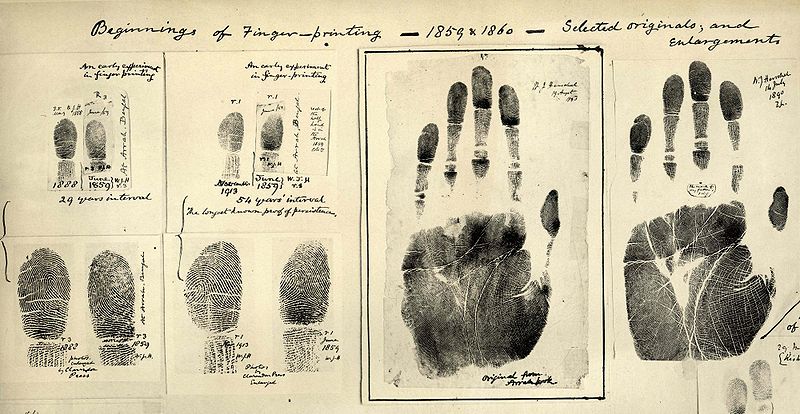
800px-fingerprints_taken_by_william_james_herschel_1859-1860First Fingerprints taken 1859/60 by William James Herschel (2).
Today, fingerprints are not only a means of identifying an individual but they can be collected at crime scenes as a tool for investigation, linking an offender to their crime and aiding to secure a conviction.

References

Webpages
  1. Australian Police: Fingerprint History http://www.australianpolice.com.au/dactyloscopy/fingerprint-history-1/
  2. Fingerprint https://en.wikipedia.org/wiki/Fingerprint#History
  3. Jack the Ripper 1888 http://www.jack-the-ripper.org/investigation-techniques.htm
  4. South Australia Police Historical Scoiety: http://www.sapolicehistory.org/detectives.html#fingerprints
  5. Vital Clue Ignored for 50 Years  Alberge, Dalya (9 December 2012). "Vital clue ignored for 50 years". London: Independent. Retrieved 28 December 2015.
    Books
  6. Grew, Nehemiah (1684). "The description and use of the pores in the skin of the hands and feet". Philosophical Transactions of the Royal Society. 14: 566–567. 
  7. Galton, Francis. Finger Prints. Macmillian, 1892.
  8. Worsley, Lucy. A Very British Murder: The Story of a National Obsession,  BBC Books, St Ives. 2014

Friday, October 14, 2016

Photo Friday: Random Things

original post: http://karenjcarlisle.com/2016/10/14/photo-friday-random-things/

Random pictorial representation of my week:
Fun: New set of dice- just in time for tomorrow's D&D game...
Accomplishment: Inktober accouterments...
dsc_1925_20160920093658513 inking_copyright2016karencarlisle-3
Thought provoking: Ivy smothering  a native gum tree - an analogy of early Australia being strangled by outside culture?
Satisfaction: Eye of the Beholder & Other Tales is now in the library system...
ivyontree_europesmotheraus_copyright2016karencarlisle-1 library-book_copyright2016karencarlisle-2
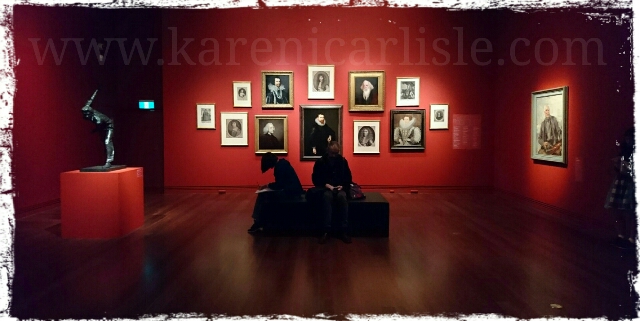
Inspiration: A trip to the SA Art Gallery.
art-gallery_copyright2016karencarlisle
Photos:©2016 Karen J Carlisle. All Rights Reserved.
If you wish to use any of my images, please contact me.

Monday, October 10, 2016

A Chink in the Armour (aka Anxiety Sucks!)

original post:http://karenjcarlisle.com/2016/10/09/a-chink-in-the-armour-aka-anxiety-sucks/

The past few weeks have been exhausting.
Little things can rouse the black dog: library books not returned, car overheats, can't attend a friend's funeral. He pokes and prods, clawing away at my carefully constructed armour. Before long he's found that chink - a way in, allowing the smallest grain of doubt to niggle. And niggle it does. Endlessly.
The legs tick. The hand shakes. The heart thuds. With each quickened breath, the muscles stiffen and clench until the nerves complain. Pain spreads, first through the lower back, then through the chest. Grabbing. Spreading down the arm.
Worry is next. It's inevitable. No matter how much I try to distract myself, try to convince myself it is all in my head, I fail. The pain lingers, spreads, intensifies. A sense of dread.
Deep breaths. Soothing music. An overdue scrummage in the medicine cabinet - to avoid another long, bumpy ambulance ride, the swinging doors and and fluorescent lights. Each time there is a sense of guilt for wasting their time, as the nurses poke and prod me and hook me up to the machine. I feel like Frankenstein's monster waiting for the lightning to strike. Then, finally, the doctor says not to worry. All is okay.
There's a final growl from the black mutt. Self-judgement follows. Why do I feel I failed?

Friday, October 7, 2016

Photo Friday - Inktober 2016 update

original post: http://karenjcarlisle.com/2016/10/07/photo-friday-inktober-2016-update/


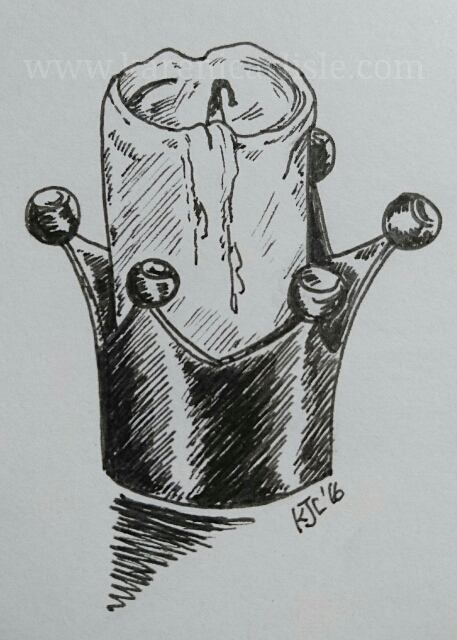
Iday-1-candle-on-tablenktober is in full swing. I really need practice on my proportions and shading. It has just been too long since I last picked up my nib pen. Sigh.
Here's a rundown of this weeks ink drawings (with a special request for Henry Collins, by my friend Sharon).
I started with a thin ink pen, and did a quick pic of one of our candles (as we had a black out) but remembered why I prefer a nib, which gives better control over varying thickness (and it swoops beautifully over the paper).
This week I concentrated on characters from my books and some steampunk ringins...
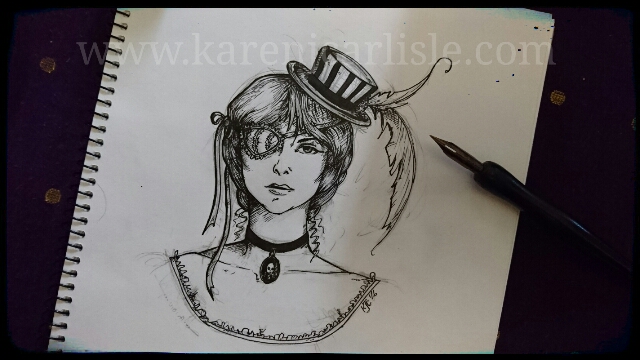
Day 2: Viola Stewart:
day-2-viola

Day 3: Doctor Jack, Day 4: Henry Collins (my favourite for the week), Day 5: a steampunk friend (loved the pipe)
day-3-doctor-jack_copyright2016karencarlisle day-4-henry-collins-for-sharon_copyright2016karencarlisle day-5-pipe_copyrhgit2016karencarlisle
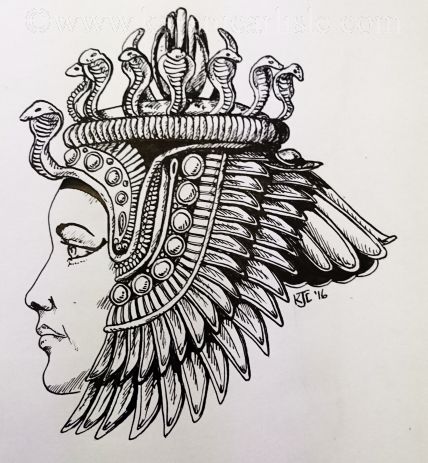
Day 6: Inspired by Eye of the Beholder: day-6-cleonopencil_copyright2016karencarlisle
Art and Photos:©2016 Karen J Carlisle.
All Rights Reserved.

Tuesday, October 4, 2016

Spend Halloween with Jack the Ripper and the Mummy

original post: http://karenjcarlisle.com/2016/10/04/spend-halloween-with-jack-the-ripper-and-the-mummy/

Halloween is coming.
Why not spend it with Jack the Ripper or the mummy?
Get your copy of Doctor Jack & Other Tales and Eye of the Beholder & Other Tales for some halloween reading.
You can buy from Amazon, Book Depository (free post to Australia) or directly from me at Adelaide's Halloween Con (details here)
vs2bookssmall

And here's your Halloween bonus:Doctor Jack t-shirt now available on Redbubble!

Available now from my Redbubble store. Original artwork by me!
Redbubble are made from cotton and are sweatshop free and ethically sourced, with free postage to Australia if you spend $60+

Sunday, October 2, 2016

Party on, Denizens!

original post: http://karenjcarlisle.com/2016/10/02/party-on-denizens/

On Saturday morning 24th September (Australian time) the party started - and went on til midnight Saturday, US eastern shore, Pacific time. That's two days! We celebrated the second anniversary of Scribblers Den - a steampunk writers group, within Steampunk Empire.
I made a chocolate cake. We shared virtual tea, piccies, poems and even haikus.
 den-of-antiquity-tea-party_cake2_180924 den-2year-party-160925
den-of-antiquity-tea-party2_180924 stevemoore2doa_party160925
Meet some of the splendiferous denizens of the Scribblers' Den, David and Steve. We're a friendly lot. If you are a writer of steampunk - or want to be one - come and say hi.
 davidleesummersdoa_party150925  stevemooredoa_party160925
Members wrote posts about Scribblers Den:
  • Jack Tyler wrote the group's support and his writing
  • N.O.A. Rawle collected thoughts from various members, including yours truly, about their experience with the group - and revealed the cover of our latest project.

Den of Antiquity Update.

Members of our writing group hail from around the world  providing varying views on the theme of In the Den. For my part, I wanted to inject a little bit of Australiana with my story. All That Glitters is set in South Australia amid the gold-rush days of the mid 1800s.
Den of Antiquity is a steampunk anthology with short stories from many of our members. On Saturday I announced the details. Now we have a proposed date for publication. Look out for Den of Antiquity from 5th November, 2016.
Photo (c) 2016 Karen Carlisle and D Carlisle.
Photos of Steve Moore: (c)2016 Leo Galeone
Photo of David Lee Summers (c) 2016 Kumie Wise

Saturday, October 1, 2016

Inktober 2016

oringinal post:  http://karenjcarlisle.com/2016/10/01/inktober-2016/

I'm doing the inktober challenge again this year: ink a drawing every day during October, then post it.
Inktober started in 2009 by Jake Parker. Since then many artists have taken up the challenge. For more information, check out Jake's webpage. There is an official prompt list (that I may need to use). The rules are simple:
  • Make a drawing in ink
  • Post it online
  • Hashtag it with #inktober and #inktober2016
  • Repeat - 31 days. 31 inks.
I'll post a drawing each day on twitter and facebook - and do a round up on this blog.
Today was a fast drawing: It's been ages since I've had time to draw. I'm looking forward to relaxing and taking some me time.
_20161001_140200